5 Challenges of Assessing Student Writing: Insights and Solutions for Teachers


7 min

Education

Suzanne Ireland
Share


Assessing student writing is one of the most rewarding – and most challenging – parts of teaching.
Each piece of writing offers a window into a child’s thinking, creativity and progress. Yet behind every carefully marked essay or narrative lies hours of invisible work: ensuring consistency in writing assessment, providing meaningful feedback and supporting a classroom full of diverse learners.
To better understand these challenges, we surveyed teachers from across Australia and New Zealand. The responses revealed five major writing assessment challenges – many of which will feel familiar.

1. Time and workload
Ask any teacher what makes writing assessment hard, and the first answer will likely be: time.
Writing assessment is one of the most time-consuming parts of the job. Each piece requires careful reading, personalised feedback and reflection against criteria. Teachers want to make assessment meaningful, provide timely feedback and use the insights to inform learning.
As one teacher put it, “It’s not just about marking – it’s about giving feedback that actually helps them grow.”
Unfortunately, finding the time for formative assessment and student conferencing often feels impossible in a busy classroom environment.
2. Consistency and clarity
Consistency is another major challenge. Writing is complex with so many different skills coming into play and writing assessment can feel subjective. What one teacher thinks is above standard, another might see as at standard.
Many educators shared that they’re not always sure what to expect at each year level – or how to distinguish between pieces that are technically sound versus those that show genuine creativity and voice.
Without shared benchmarks, consistency across classrooms, year levels or schools becomes difficult. While moderation sessions help, they take time, planning and expertise.
3. Teacher confidence and knowledge
Writing assessment requires deep professional judgement. Teachers often question whether their decisions are accurate or evidence-based. How do we identify a student’s specific strengths and weaknesses? How do we know if our feedback is truly helping them progress?
Many teachers also pointed to the challenge of supporting diverse learners – students with dyslexia, EAL/D backgrounds or additional learning needs – while keeping expectations fair and growth-focused.
Even experienced educators sometimes feel uncertain about what progression should look like across different year levels and genres and how to address the individual needs of their students.
4. Student abilities and engagement
Every classroom is a mix of reluctant writers, prolific storytellers and everything in between.
Some students struggle to get words on the page, while others write six-line sentences without punctuation. Assessing across this spectrum can feel like comparing apples and oranges.
Teachers also highlighted the challenge of balancing creativity with correctness – celebrating a child’s ideas while correcting grammar, spelling and sentence structure.
Add to that the growing need to build writing stamina and confidence, assessing writing becomes more than a technical task – it’s a deeply human one.
5. Making assessment meaningful
Many teachers often feel torn between summative assessment for reporting and formative assessment for learning.
Formal assessments and rubrics serve an important purpose, but they can sometimes narrow writing into checklists and formulas designed solely to give students a final mark or level.
As one teacher shared, “We use summative assessment constantly, but we don’t have time to use it formatively – and that’s where the real growth happens.”
Teachers are also thinking about the future – how to make writing assessment culturally responsive, curriculum-aligned and relevant in an era of AI tools and digital disruption.
The Seven Steps solution
These challenges don’t come from a lack of care or skill – they come from the complexity of writing itself. Writing is both art and science, personal and procedural. Teachers are trying to honour each student’s unique voice while still providing consistent, fair and actionable feedback. Teachers deserve tools that make this possible.
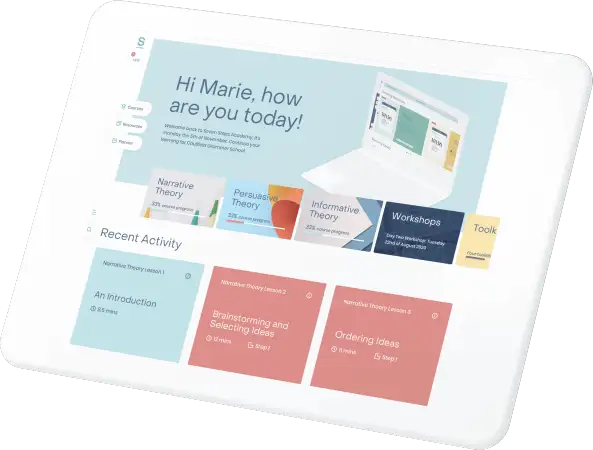
That’s why Seven Steps is partnering with Mark My Words to launch a new AI-powered writing assessment tool in Term 1 2026.
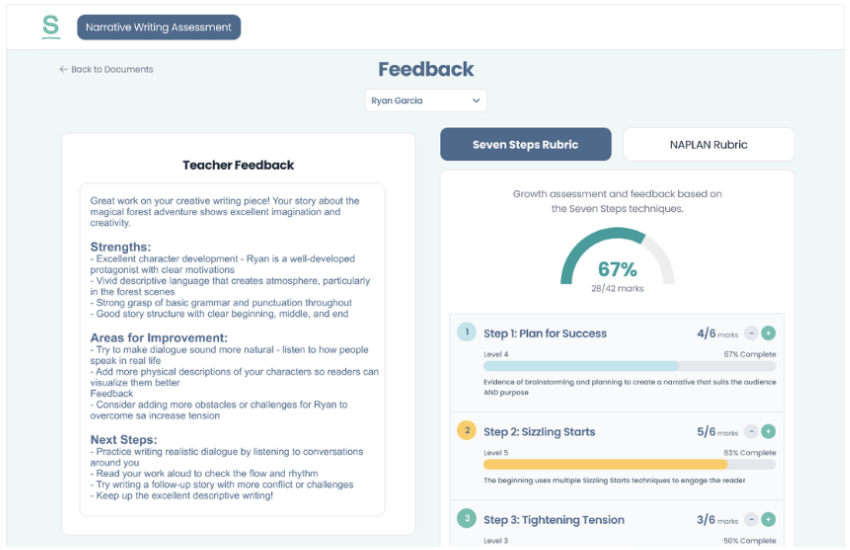
This new tool is designed to:
- save teachers time on marking
- improve consistency across classes
- increase confidence in assessing writing
- provide students with targeted next steps.
At Seven Steps, we have always strived to empower teachers and equip them with the tools and techniques to unlock every student’s writing potential. With this tool, teachers can finally make writing assessment a true driver for learning. Because ultimately, the goal of writing assessment isn’t just to grade – it’s to help every student become a more confident, capable communicator.
Want to see the new AI-assessment tool in action? Book a 1:1 demo.