
Empowering EAL learners: A structured, creative approach to writing


5 min

Education

Suzanne Ireland
Share


EAL students aren’t just learning how to write; they’re learning how to express their thoughts, stories and opinions in a new language.
Without a structured, confidence-building framework, it’s all too easy for students to become overwhelmed by the sheer number of things they need to juggle – grammar, vocabulary, spelling, punctuation, structure.
By shifting the focus from polished products to the process of writing,
you’ll give these learners the tools they need to thrive –
not just in English, but in every subject where language is the key to learning.

Teaching students who speak English as an Additional Language (EAL) (or ESOL/ESL) is both deeply rewarding and uniquely challenging.
Learners are expected to produce polished texts without first mastering the building blocks of great writing. Teachers, meanwhile, must balance explicit language instruction with fostering imagination and personal expression.
So how do you help these students develop great writing skills?
Evidence shows that the key lies in a structured, step-by-step approach that makes writing achievable, engaging and deeply rewarding for every learner.
The power of a Step-by-Step approach
When writing is broken down into clear, manageable techniques, students are more likely to take risks, experiment with language and engage in the writing process. A framework such as Seven Steps to Writing Success has been used internationally to do just that – giving teachers practical strategies that shift writing from daunting to doable.
These strategies are particularly powerful for EAL learners, who benefit from repetition, oral rehearsal and explicit modelling. Importantly, they also give students permission to be creative before worrying about spelling or grammar – flipping the focus from correction to communication.
Here are seven principles that can transform writing instruction for EAL learners across international contexts:

“As an EAL/D teacher, Seven Steps to Writing Success really supports our pedagogy. It understands the importance of quality teaching, explicit modelling and oral interaction!”
~ Renata Ninevski, Jesmond Public School
1. Break writing into bite-sized chunks
EAL students often face cognitive overload – trying to juggle grammar, vocabulary, structure and creativity all at once. By breaking writing into small, manageable parts, teachers help students focus on one skill at a time.
A step-by-step approach (such as the Seven Steps to Writing Success) allows students to focus on one technique at a time – whether it’s crafting a memorable ‘Sizzling Start’, developing tension or tightening a conclusion. This approach reduces the feeling of being overwhelmed, builds confidence and makes writing manageable for students of all abilities.
“Using Seven Steps shows students that writing can be quick and fun and doesn’t need to be a long and laborious task. This is especially helpful for students who struggle or have negative associations with writing activities.”
– Rosie Russell, Deputy Principal, Hollywood Primary School
2. Build confidence through purposeful repetition
Repeating the skills they have learnt through engaging and increasingly challenging tasks, is a powerful confidence-builder. By revisiting the same writing skill in various genres (narrative, persuasive, informative), students develop and consolidate their understanding.
A scaffolded routine – like practicing Sizzling Starts in a narrative before applying similar hooks in persuasive pieces – helps EAL learners transfer skills across contexts. Over time, that repeated practice leads to a deeper understanding and a willingness to experiment.
3. Model what great writing looks like
EAL learners benefit immensely from seeing and hearing examples of strong writing before attempting it themselves. Together with the class, teachers can co-construct paragraphs, highlight key features on the board, and model their thinking as they revise each sentence.
In a framework like Seven Steps, each Step comes with worked-through examples, so students see not only what a great tension paragraph should look like, but how to get there. This explicit modelling clarifies expectations and ensures students internalise key techniques and structures.
“When we read various texts, my students consistently point out the writing techniques they’ve learnt from the Seven Steps. They showcase their improved understanding of writing and their ability to analyse and appreciate the craft of authors.”
–Daniela Morsella, Year 4 Teacher
Join a free live masterclass
Try out the award-winning, research-based Seven Steps approach to transforming student writing at one of our upcoming webinars.
Sizzling Starts: The Easiest Way to Improve Students’ Writing
4. Use speaking as the starting point for writing
For EAL students, oral rehearsal is often the bridge between thinking in their native language and expressing ideas in English. Group brainstorming sessions, pair discussions of key vocabulary and quick ‘talk‐throughs’ of an outline all give learners low-stakes opportunities to learn from each other and shape their thoughts.
When these speaking strategies align with a writing framework – such as discussing the elements of a persuasive argument before drafting – the transition to pen and paper becomes smoother, and errors feel less intimidating.

“If you can’t say it, you can’t write it, so speaking is very important for our students. The Seven Steps approach helps develop oral language.”
– Mary Semaan, Head of Primary, Al Sadiq College
5. Use structure to empower, not restrict
EAL students often come to writing tasks unsure where to start or how to shape their ideas. That’s where structure becomes a powerful ally. A clear framework helps students understand how writing works – not just what to say, but how to organise it effectively.
Instead of asking students to write a full text from scratch, teachers can guide them through key building blocks: an engaging opening, logical development of ideas and a strong ending. That scaffolding doesn’t stifle creativity; instead, it gives learners a reliable roadmap they can revisit independently, reducing guesswork and anxiety.
6. Focus on ideas first, grammar second
Many AI writing tools emphasise error-correction – highlighting every misplaced comma or verb agreement issue. For EAL learners, however, this can reinforce a fear of making mistakes.
A more effective approach is to let students concentrate on expressing a clear idea, crafting an engaging narrative, or developing an argument – then address grammar in subsequent editing stages. By separating idea generation and grammar refinement, teachers help students take risks without freezing up, leading to more authentic, creative, meaningful writing.
“They have become more confident as they’re well-prepared and know the techniques to generate great ideas and produce amazing stories. Only the sky is the limit.”
– Nurafidah Binti Mohd Amin, Primary Teacher, Australian Islamic College Forrestdale
7. Make writing collaborative and fun
Writing shouldn’t be a silent, solitary endeavour. Interactive group activities – such as peer review circles, shared story-building games or collaborative writing challenges – help EAL students learn from each other.
When peers offer constructive feedback (“Try adding more descriptive verbs here.”), learners develop their skills and vocabulary more naturally than they would via isolated drills. Plus, the social dimension of writing fosters a supportive environment where mistakes feel like part of the learning journey, not a dead end.
Why this matters for international schools
International schools often have classrooms filled with students from diverse linguistic and cultural backgrounds. This makes structured, creative writing instruction more important than ever.
-
Confidence first: A clear framework helps students feel safe enough to take risks in English.
-
Creativity unlocked: When writing isn’t weighed down by correction, students’ unique voices shine through.
-
Equity in learning: Breaking down writing into accessible steps ensures that no student is left behind, regardless of language level.
Beyond language acquisition, these skills prepare students for life: the ability to think critically, communicate clearly, and express ideas with confidence are essential for global citizenship.
One school’s story
At Al Sadiq College in Sydney, where most students come from EAL backgrounds, writing outcomes have risen well beyond national averages. Their secret? A commitment across their primary school for structured, explicit instruction – where teachers use Seven Steps to Writing Success to build confidence, competence and creativity in every learner.
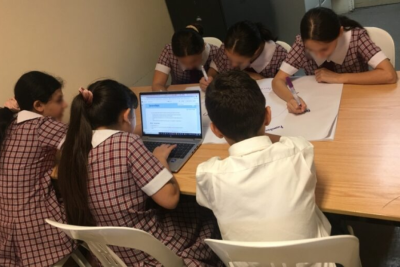
Their Head of Junior School, Mary Semaan, shared how the Seven Steps program has made such an impact on their students’ writing:
“We wanted a writing program that was going to be explicit but at the same time, we wanted something that was going to give every student the opportunity to succeed.
It fit in with our pedagogy really well because we taught it explicitly, but we could also go into deep learning because our kids were asking questions and being creative thinkers using Seven Steps, so we actually met both sides.
In every classroom, across the whole school, you’ll see students talking, writing and improving together. Seven Steps is part of our school culture.
We’re really passionate about Seven Steps. Before, teaching writing was like: Ugh, we’ve got to teach writing again. Now, it’s like: Wow! This really works!”
– Mary Semaan, Head of Primary, Al Sadiq College
When EAL students are given the right tools – both a clear framework for writing and plenty of opportunities to speak, listen and revise – they don’t just learn how to write. They learn to love writing. And that’s the secret to real, lasting success.
Book a free Introductory Session
Ready to transform writing in your school?
Click the button to schedule a free consultation.