Top tips for your persuasive writing lessons


5 min

News

Sarah Bakker
Share


Mosquitoes, marshmallows and strong opinions
On Tuesday 24 February, nearly 10,000 students across Australia and beyond logged in for a persuasive writing lesson hosted by Pobble in partnership with Seven Steps to Writing Success. The lesson shared practical persuasive writing tips to help students craft strong writing.
What followed wasn’t a quiet online lesson – it was a fast-moving, collaborative writing event filled with strong opinions and a heated debate about one question:
Camping – love it or hate it?
Some students had fond memories of toasting marshmallows, sleeping under the stars and days filled with adventure. Others couldn’t forget the muddy tents, stinky outdoor toilets and mosquito bites galore.
It was exactly what persuasive writing needs – genuine disagreement.


Why it worked
We’ve all seen students stare at a blank page when faced with an unfamiliar prompt under timed conditions in the NAPLAN Writing Task. This session flipped the script for NAPLAN writing preparation with practical tips and short writing bursts that helped them push past the hardest part – simply getting started.
If you weren’t able to join us, here are three top tips to turn reluctant writers into masters of persuasion in the lead up to the big day:
TIP 1
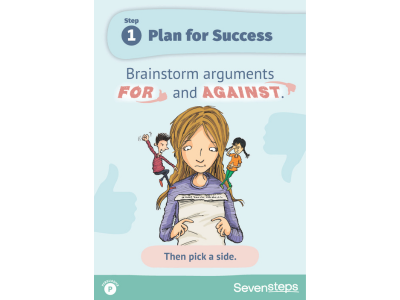
Brainstorm both sides of the argument
The 5 minutes of planning at the start of the NAPLAN writing task are the most important. The more ideas students come up with in that time, the more they will have to write about. If it is a persuasive prompt, encourage students to brainstorm both sides of the argument before picking a side.
In the session, ideas poured in from classrooms everywhere, painting wildly different pictures of Aussie camping trips.
Love camping!
Adventure, family time, fresh air, cooking outdoors, no technology, fun activities, campfires, time to relax, being in nature, hanging with friends, visiting new places, sleeping under the stars, night walks, meeting new people, learning new skills
Hate camping!
Mozzies, creepy crawlies, snakes, being woken up early, rain and mud, being too hot or too cold, outdoor toilets, no wifi, no showers, no electricity, no privacy, burnt food, going to the toilet at night, uncomfortable beds, wild animals
TIP 2
Master the Sizzling Start
Instead of formulaic openings like ‘I think camping is amazing because …’, encourage students to use Sizzling Starts techniques to engage and persuade the reader.
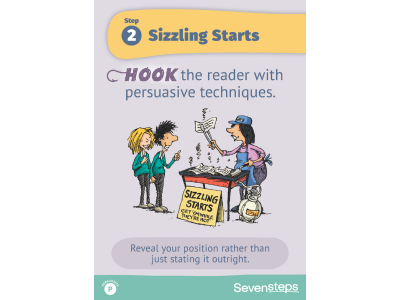
In the lesson, students crafted opening sentences that hooked the reader immediately by showing rather than telling the reader why they love or hate camping.
‘Picture this; you gaze up at the black, black sky and find it is lit up with thousands of glowing diamonds twinkling down at you like a heavenly host of angels. Nothing beats the outback sky at night, clear, quiet and kind.’
Then they experimented with rhetorical questions, sensory details, sound effects and dialogue to bring the reader on board.vThe results were extraordinary.
Some writers used humour:
‘A doctor’s visit. A big needle. Pain in my bottom. All of this because I scratched a mosquito bite until it became infected. Do you think I love camping?’
Others combined several techniques at once:
‘Whiizzz… PLOP! Splash! ‘I got one!’ echoes through the morning mist. The smell of bacon and eggs wafts down to the river. It is so peaceful and my whole body is relaxed.’
TIP 3
High-momentum writing bursts
By using short, timed writing sprints, we removed the assessment pressure. Students responded to an unfamiliar prompt and wrote within a time limit – exactly what is required in a NAPLAN task – but they did it with a sense of play and confidence rather than anxiety.
As the lesson continued, students saw their persuasive pieces take shape in real time. They shared their ideas, their writing and their opinions sharpened.
Students experimented with persuasive devices, rebutted counterarguments and crafted conclusions designed to leave a lasting impression on the reader.
Real writing, real results
Instead of just passively watching, students shaped the lesson. Classrooms laughed together, debated fiercely and discovered that strong writing begins with strong opinions.
By the end of the session, thousands of students had crafted complete persuasive pieces – some ending with a call to ‘embark on an adventure’, others firmly advising readers to ‘stay at home!’ Students weren’t just practicing persuasive writing; they were experiencing it.
Camping may have divided the chat.
But great writing brought everyone together.
Bring this energy into your school
The Seven Steps approach, combined with Pobble’s engaging prompts, creates a classroom culture where every student has a voice. Try the lesson for yourself and see the impact.
From classroom buzz to clear next steps
Turning a high-energy lesson into measurable progress is the real challenge. Once the pens are down, the focus shifts: What does each student need to do next to grow?
Providing criteria-aligned feedback for 20+ unique voices is a massive undertaking. You want to give every student a roadmap to success, but you shouldn’t have to lose your weekends to do it.
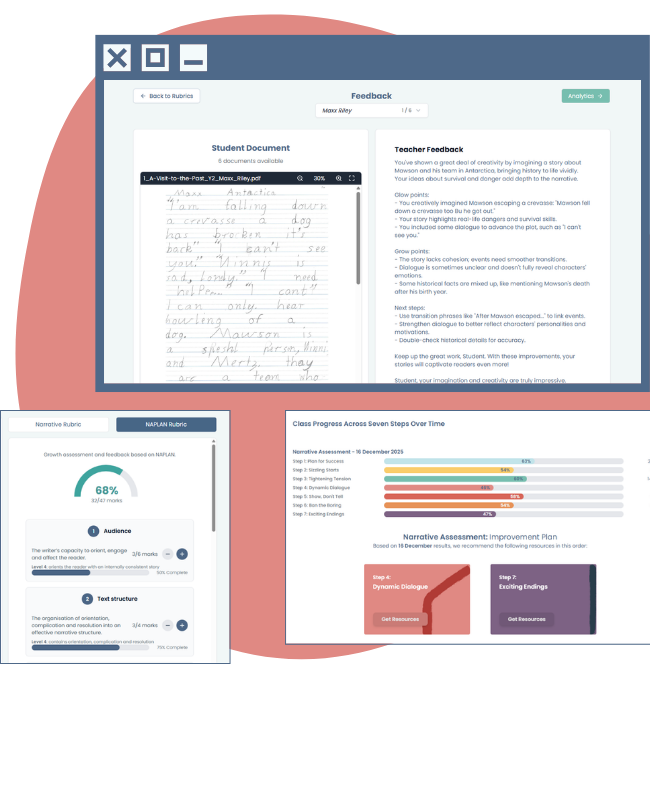
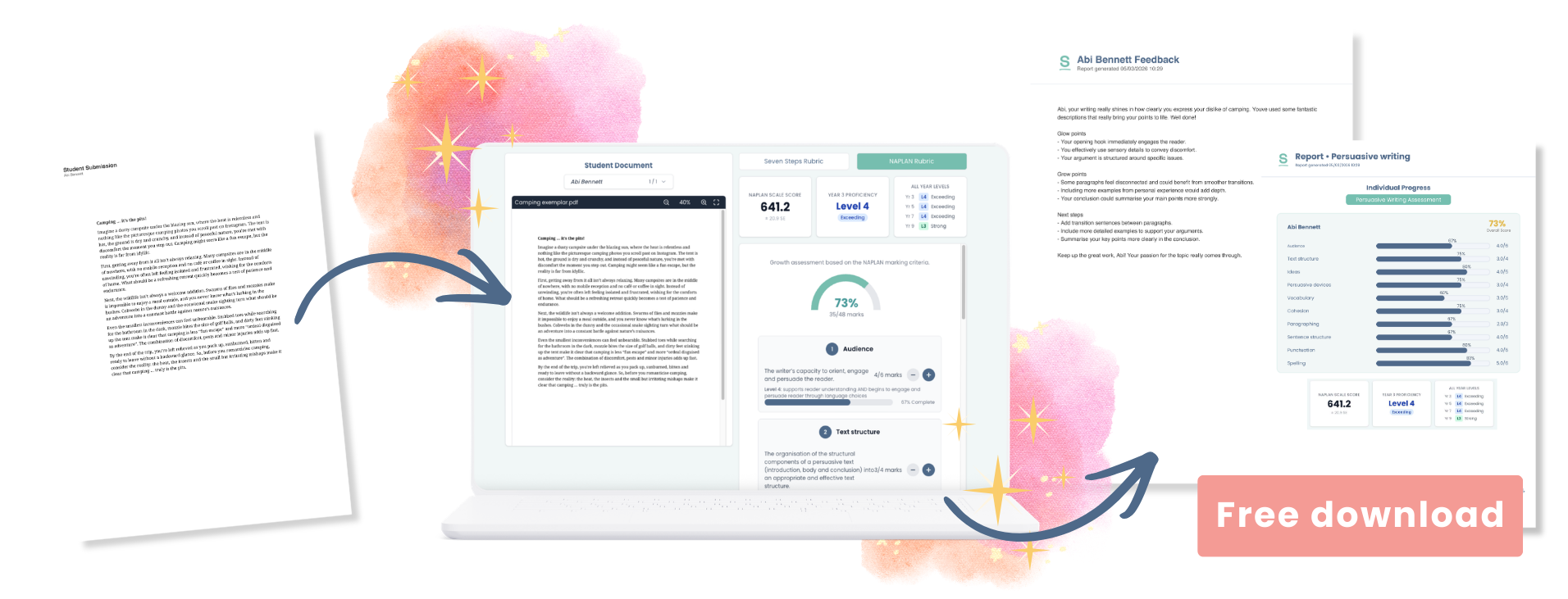
We’ve developed an AI-powered assessment tool that works like a digital co-teacher. It analyses full pieces of writing in minutes, identifying specific strengths and focus areas across the NAPLAN criteria and Seven Steps rubric.
Want to see exactly what kind of feedback it generates? We’ve assessed a sample from the lesson – complete with NAPLAN scores and feedback. Check it out here 👇
Curious to see it work with your own students’ writing?
Book a quick demo, bring a writing sample and see the AI tool mark it live. You’ll see exactly how it identifies next steps, so you can spend less time marking and more time teaching.


AI-POWERED ASSESSMENT
Turn assessment into action
Our new AI-powered assessment tool helps you quickly understand student needs and take targeted action.